Article: Are Essential Oils Safe for Your Beard and Skin?

Are Essential Oils Safe for Your Beard and Skin?
Short answer: sometimes. But “natural” tells you almost nothing about it. Whether an essential oil is safe on your skin depends on the specific material, the dose, how it was processed, and whether it is stable and appropriate for a leave-on product. Some naturals are gentle. Some are among the most documented skin allergens in all of dermatology. The word “natural” does not sort them.
One thing that gets misunderstood in beard care is that word. People hear it and their brain jumps to food, wellness, purity. But skin is not a stomach. It does not care whether an ingredient sounds romantic. It responds to concentration, chemistry, processing, stability, and whether the material belongs in a leave-on product.
Why “natural” doesn’t mean safe
Because plenty of things are natural and outright hostile to skin. Poison ivy is natural. Citrus oils are natural and can be dangerous in sun if handled wrong. Cinnamon and clove-type oils are natural and can be brutal on skin. Tea tree is natural and still a documented irritant for some people. Origin is not a safety rating.
Are essential oils bad for your skin?
Not inherently. But they are not the gentle default they are marketed as, and several are well-documented allergens. A pet peeve of mine: brands that build their entire pitch on “essential oils only, because natural is safer” almost never have a study to point to. The claim sounds scientific. It isn’t. It is marketing wearing a lab coat.
The actual dermatology literature runs the other direction. One review counts around 80 essential oils reported to cause contact allergy. Essential oils are complex mixtures containing known allergens: linalool, limonene, eugenol, citral, cinnamaldehyde. That doesn’t make them villains; it makes them materials that need dosing and respect, like any other.
Essential oils vs. absolutes vs. resins vs. synthetics
“Natural” covers very different materials, and each deserves the same caution rather than the same free pass. Essential oils are only one category.
Absolutes are solvent-extracted aromatics. Gorgeous, deep, and not automatically gentler. Jasmine absolute, benzoin, balsams, and resinoids can all carry allergenic constituents. Oakmoss is the classic case: natural, beautiful, historically important, and one of the most recognized fragrance allergens in existence. That is why it has been heavily restricted and reformulated to strip out atranol and chloroatranol.
Resins and extracts sometimes have more real skin-benefit relevance than the essential oil of the same plant. Frankincense is the perfect example. The anti-inflammatory reputation of Boswellia comes largely from boswellic acids, resin compounds too heavy to survive steam distillation, so they are effectively absent from the essential oil. “Frankincense extract” and “frankincense essential oil” are not the same material and should not be marketed as if they are.
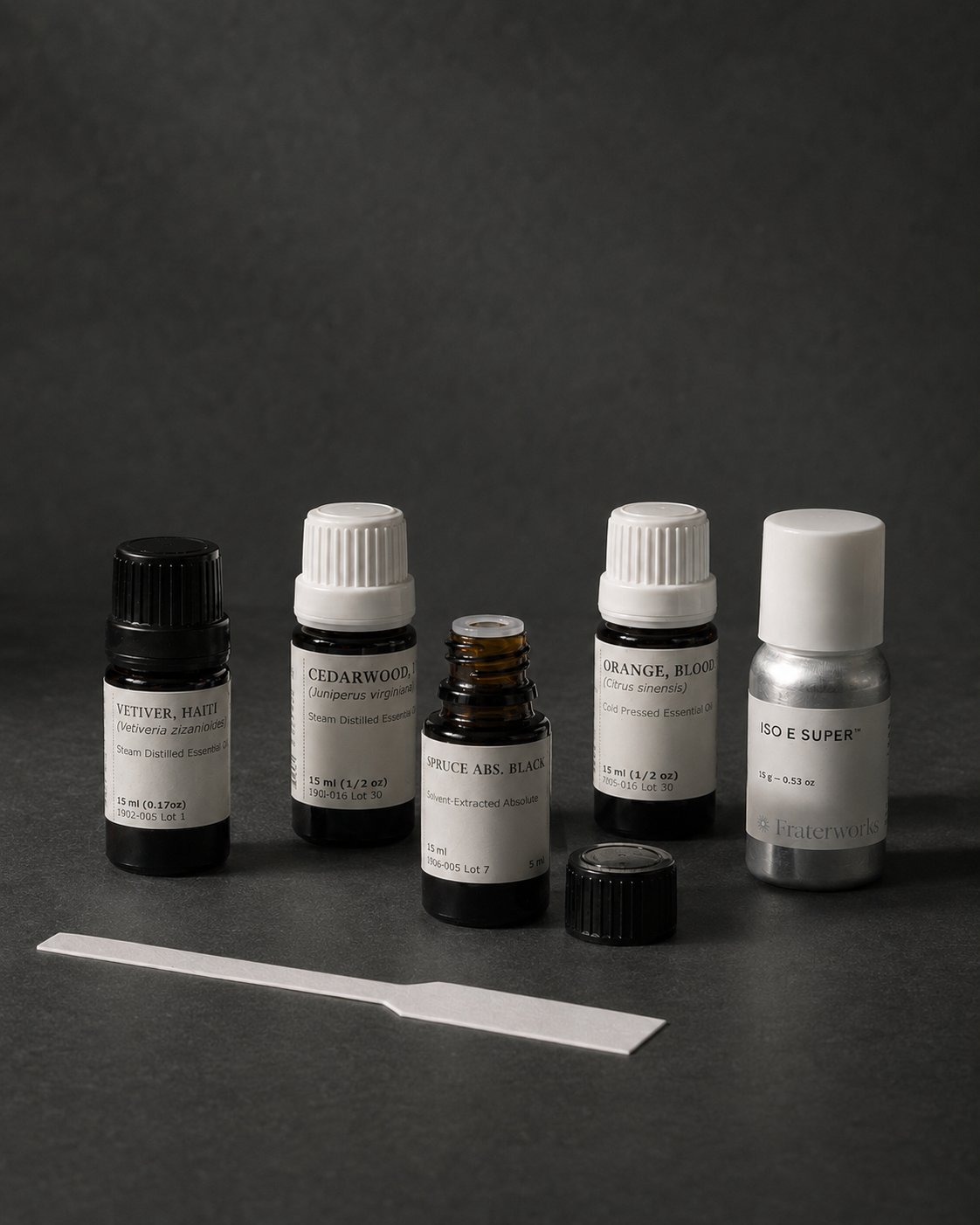
Synthetics like Iso E Super are usually single molecules or defined mixtures. Easier to dose, test, restrict, and understand. That does not make them automatically safe. It makes them predictable, which a 200-molecule natural extract that varies by harvest, origin, storage, and oxidation is not. The IFRA safety assessment process is essentially the same for both single-molecule synthetics and complex naturals. There is no such thing as an intrinsically safer type of fragrance material.
Essential oils vs. fragrance oils: is one safer?
Neither category is automatically safer: it depends on the specific material and how it is dosed. “Fragrance oil” usually means a synthetic scent blend, and “essential oil” a plant distillate or expression, but that origin label doesn’t settle safety on its own. A well-characterized synthetic used within its limits can be gentler and more predictable than an aggressive essential oil used badly, and a carefully dosed essential oil can be perfectly appropriate for skin. Both are governed by the same IFRA framework precisely because both can carry allergens.
So the honest comparison is not natural versus synthetic. It is: which specific material, at what percentage, in what kind of product, with what documentation behind it. A responsible formula can be built either way, and a careless one can be built either way too.
So what actually makes an ingredient safe?
Not its origin. Its assessment. The real hierarchy is not natural = safe, synthetic = dangerous. It runs by how well a material is understood and controlled:
- Safest: a properly assessed material, used below safe dermal limits, stable, and appropriate for leave-on contact.
- Riskier: high-allergen naturals, oxidized essential oils, citrus handled wrong, spice oils, oakmoss issues, and unknown fragrance oils with no IFRA documentation.
- Worst: “natural” used as marketing with no safety thinking behind it.
What actually conditions your beard, then?
The carrier oils, mostly. Not the scent. In most beard oils the carriers are doing the real work: softness, conditioning, skin comfort. The aromatics are mostly there for scent, with possible secondary benefits depending on the material and the dose. When a brand sells you on the botanical magic of its fragrance, it is usually selling the part of the bottle doing the least.
How I choose ingredients at Folium
I choose ingredients because they belong in the formula, not because they sound natural. I do not oppose natural materials: I use them, and I love them. But natural is not automatically gentle, synthetic is not automatically harsh, and safe formulation matters more than the romance of the ingredient list. I would rather be honest about what an ingredient is doing than pretend every botanical is a miracle active.
Frequently asked questions
Are essential oils safe to put on your beard?
Yes, when they are properly diluted in a carrier oil and kept within safe use levels. Essential oils are not meant to be applied undiluted to skin. The risk comes from high concentrations, oxidized oils, or materials that are irritating regardless of dose, not from essential oils as a category.
Which essential oils are worst for sensitive skin?
Common problem materials include cinnamon and clove-type oils, oxidized citrus oils, and oil-of-oregano-style spice oils, all of which can irritate or sensitize skin. Tea tree is a well-documented allergen for some people. Sensitivity is individual, so patch testing a new product is always sensible.
Is natural beard oil better than one with synthetics?
Not automatically. “Natural” describes where an ingredient came from, not how safe or effective it is. A well-formulated beard oil using synthetics can be gentler and more stable than a poorly formulated all-natural one. What matters is the specific materials, the dose, and the formulation, not the origin story.
Do essential oils actually condition your beard?
Mostly no. That job belongs to the carrier oils. Essential oils are primarily there for scent, with some possible secondary benefits depending on the material and how much is used. The softness and skin comfort you feel from a beard oil come chiefly from the base oils, not the fragrance.
About the author. Aleks is the founder and formulator of Folium Beard Co., a small-batch grooming and fragrance studio in Winter Garden, Florida. He formulates every product himself and studies perfumery intensively, having worked through several thousand pages of industry texts, technical literature, and research on fragrance materials and skin safety. Folium is where that study becomes practice.